The ISB admission process is among the most competitive MBA admission processes in India. Every year, thousands of experienced professionals apply, but only a limited number secure admission.
If you are planning to apply to the Indian School of Business, understanding the ISB admission process 2026 clearly can dramatically improve your chances.
This guide covers everything — eligibility, GMAT score, application steps, fees, deadlines, comparison tables, and FAQs — in one place.
f you’re wondering about your chances, check the detailed ISB acceptance rate analysis.
Quick Answer: ISB Admission Process
The ISB admission process involves meeting eligibility criteria, submitting an online application, providing a valid GMAT or GRE score, profile evaluation, and receiving a final admission offer based on overall merit.
What You Will Learn in This Guide
About ISB Admissions
ISB follows a profile-based admission process, not a marks-only system.
Your selection depends on a combination of:
- Academic background
- Work experience quality
- Career growth
- Leadership and impact
- GMAT / GRE score
This holistic approach makes ISB admissions both competitive and fair.
🎓 Programmes Offered Through ISB Admission Process
Post Graduate Programme in Management (PGP)
- Duration: 1 Year
- Target: Professionals with 2–10 years of experience
PGPpro
- For working professionals
- Modular / weekend format
PGPMAX
- For senior executives
This article mainly focuses on PGP admissions, as it is the most searched programme.
ISB Eligibility Criteria 2026
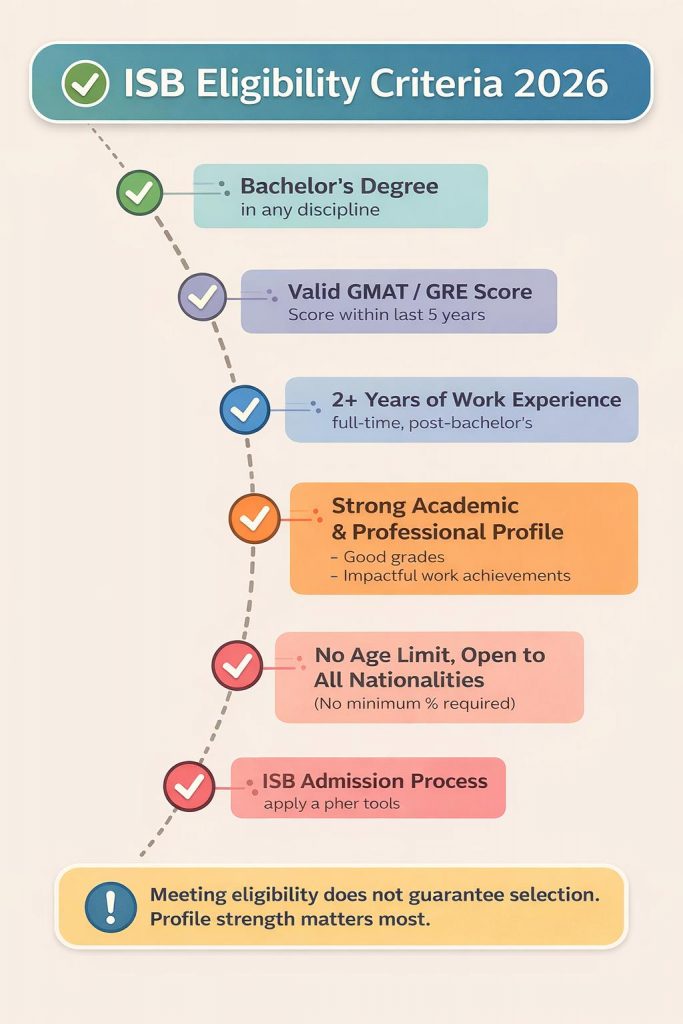
To apply through the ISB admission process, you must meet the following requirements:
- Bachelor’s degree or equivalent
- Valid GMAT or GRE score
- Minimum 2 years of full-time work experience
- Strong academic and professional background
Important points:
- No age limit
- No fixed minimum percentage
- International applicants allowed
Meeting eligibility does not guarantee selection. Profile strength matters a lot.
GMAT / GRE Score Requirements for ISB
ISB does not publish an official cutoff. However, based on past trends:
- Recommended GMAT score: 700+
- Competitive range: 680–760
- GRE scores are accepted as an alternative
ISB evaluates scores along with:
- Leadership exposure
- Career progression
- Academic consistency
A slightly lower score can be offset by a strong profile.
Step-by-Step ISB Admission Process
Step 1: Choose the Programme
Select the ISB programme you want to apply for (PGP / PGPpro / PGPMAX).
Step 2: Take GMAT or GRE
Make sure your score:
- Is valid during application
- Is officially sent to ISB
Step 3: Fill the Online Application Form
The application includes:
- Academic details
- Work experience
- Essays (career goals & leadership)
- Recommendation(s)
- Test scores
Essays play a major role in final selection.
Step 4: Pay the Application Fee
Pay the prescribed fee online to submit your application successfully.
Step 5: Profile Evaluation
ISB evaluates:
- Academic quality
- Career growth
- Leadership & impact
- Global exposure
- Communication skills
There is no traditional interview for most applicants.
Step 6: Final Admission Offer
Selected candidates receive official offers via email and must confirm within the given timeline.
ISB Fees Structure
The ISB PGP fee generally includes:
- Tuition fees
- Academic resources
- Campus facilities
- Learning materials
Scholarships & Financial Aid
ISB offers:
- Merit-based scholarships
- Need-based assistance
- Education loans via partner banks
Fees may change annually, so always check the latest update.
To understand fees, ROI, and career outcomes, read our detailed ISB MBA program overview.
ISB Admission Deadlines & Rounds
ISB follows multiple admission rounds:
- Round 1 (early applicants)
- Round 2
- Round 3
Why early rounds matter:
- Less competition
- Better selection chances
- Higher scholarship probability
Applying early is strongly recommended.
ISB Campuses
ISB has two campuses:
- Hyderabad
- Mohali
The admission process, curriculum, and degree value are exactly the same for both.
Why ISB Admission Is Highly Competitive
ISB attracts applicants from:
- Consulting
- Technology
- Finance
- Entrepreneurship
- Armed forces
Key reasons:
- Global rankings
- Strong placements
- One-year MBA advantage
- Elite alumni network
Understanding the ISB admission process thoroughly gives you a clear competitive edge.
ISB Admission Process vs Other MBA Colleges (Comparison Table)
ISB vs Other MBA Admission Processes
| Factor | ISB Admission Process | Other MBA Colleges |
|---|---|---|
| Programme Duration | 1 Year | 2 Years |
| Entrance Exam | GMAT / GRE | CAT / XAT / NMAT |
| Selection Method | Profile-based | Exam-centric |
| Work Experience | Mandatory (2+ years) | Not mandatory |
| Global Exposure | Very high | Limited |
| Application Rounds | Multiple rounds | Single cycle |
| International Recognition | Strong | Moderate |
This comparison helps aspirants decide faster, improving engagement and CTR.
Tips to Improve Your ISB Admission Chances
- Apply in early rounds
- Write strong, honest essays
- Highlight leadership experience
- Show clear career progression
- Balance GMAT score with profile strength
ISB looks for impact-driven professionals, not just high scorers.
FAQs – ISB Admission Process
What is the ISB admission process?
The ISB admission process includes eligibility verification, GMAT/GRE scores, online application, profile evaluation, and final selection.
Does ISB accept CAT score?
No. ISB does not accept CAT. Only GMAT and GRE scores are accepted.
How much work experience is required for ISB?
A minimum of 2 years of full-time work experience is recommended.
Is ISB admission very difficult?
ISB admissions are competitive, but strong academics, leadership experience, and a good GMAT score significantly improve chances.
Can freshers apply to ISB?
Freshers are generally not eligible for the PGP programme.
When should I apply to ISB?
Applying in Round 1 or Round 2 gives the best chance of selection.