
How to Prepare SAT Exam: A Complete Study Guide for 2026
Many students dream of studying abroad, but one challenge stops them: SAT preparation. Questions like “Where should I start?”, “How many months do I need?”, and “Which books should I use?” often create confusion. If you are also feeling overwhelmed, you are not alone.
The good news is that the SAT exam is highly predictable when you follow the right strategy. Instead of studying randomly, you need a structured plan, the right resources, and consistent practice.
In this guide, you will learn how to prepare SAT exam step-by-step, including the best study plan, recommended books, preparation strategies, and expert tips to help you achieve a high score.
Before starting your preparation, it is important to understand what is the SAT exam and how it is used by universities for undergraduate admissions.
Understand the SAT Exam Before You Start Preparation
Before learning how to prepare SAT exam, you must understand the exam structure. Many students start preparation without knowing the format, which wastes time and effort.
The SAT is a standardized test widely used by universities in the United States and other countries to evaluate college readiness.
SAT Exam Structure
The digital SAT consists of two main sections:
| Section | Key Skills Tested | Time | Difficulty |
|---|---|---|---|
| Reading & Writing | Grammar, vocabulary, comprehension | ~64 minutes | Moderate |
| Math | Algebra, problem solving, data analysis | ~70 minutes | Moderate to High |
Key SAT Facts
-
Total score range: 400 – 1600
-
Each section score: 200 – 800
-
Exam mode: Digital SAT
-
Test duration: About 2 hours
Understanding the structure helps you plan preparation more effectively and focus on the most scoring topics.
Table of Contents
Step-by-Step Strategy: How to Prepare SAT Exam
SAT preparation becomes easier when you follow a structured process. Instead of studying everything at once, focus on concept building, practice, and mock tests.
Step 1: Take a Diagnostic Test
The first step in how to prepare SAT exam is understanding your current level.
A diagnostic test helps you:
-
Identify weak areas
-
Understand exam difficulty
-
Estimate your potential score
For example, if your first mock score is 1050, you can create a strategy to reach 1350+ or 1400+.
Step 2: Build Strong Concepts
After identifying weak areas, focus on strengthening your fundamentals.
Important SAT Topics
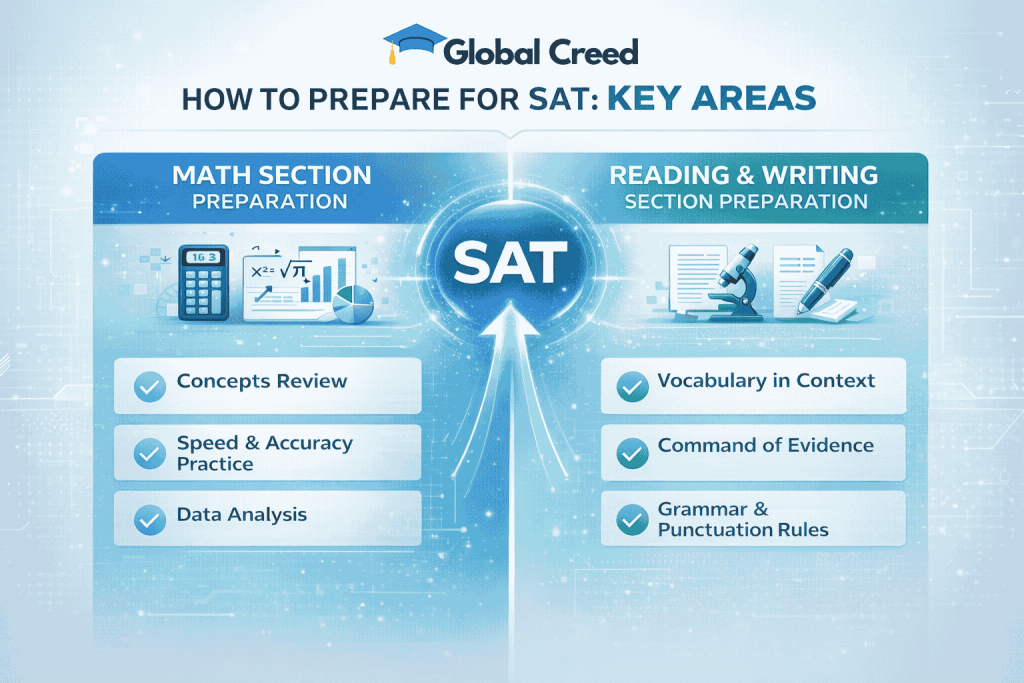
Math Topics
-
Linear equations
-
Algebra
-
Ratios and percentages
-
Geometry
-
Data interpretation
Reading & Writing Topics
-
Grammar rules
-
Sentence structure
-
Vocabulary in context
-
Reading comprehension
Instead of memorizing shortcuts, focus on understanding concepts deeply.
Step 3: Create a Smart Study Plan
Many students ask: “How long does it take to prepare for SAT?”
The answer depends on your current score and target score. However, a 3–4 month preparation plan works well for most students.
Sample 3-Month SAT Study Plan
| Month | Focus Area | Goal |
|---|---|---|
| Month 1 | Concepts and fundamentals | Learn grammar + core math |
| Month 2 | Practice questions | Improve accuracy |
| Month 3 | Mock tests and analysis | Increase speed and score |
Consistency matters more than long study hours. Even 2–3 hours daily practice can significantly improve your score.
A clear understanding of the SAT exam syllabus will help you focus on the most important topics in the Digital SAT.
Best Books for SAT Preparation
Choosing the right study material plays a huge role in how to prepare SAT exam effectively. Not all books are equally useful.
Below is a comparison of some of the best SAT preparation books.
| Book | Best For | Difficulty Level | Why Use It |
|---|---|---|---|
| Official SAT Study Guide (College Board) | Real practice tests | Moderate | Contains official exam questions |
| Erica Meltzer Reading Guide | Reading improvement | Moderate to High | Excellent for comprehension strategies |
| College Panda SAT Math | Math mastery | High | Advanced math problem solving |
| Princeton Review SAT Prep | Beginner students | Easy to Moderate | Simplified explanations |
For most students, combining Official SAT Guide + College Panda Math works very well.
Section-Wise Preparation Strategy
To score high, you must prepare each section strategically.
How to Prepare SAT Reading & Writing
This section tests your critical reading and grammar skills.
Preparation Tips
-
Read articles daily (science, history, economics)
-
Practice grammar rules regularly
-
Improve vocabulary through context
-
Focus on passage-based questions
Many SAT toppers recommend reading editorials from major newspapers to improve comprehension speed.
How to Prepare SAT Math
The SAT math section is scoring but requires strong conceptual clarity.
Key Math Strategies
-
Master algebra concepts first
-
Practice word problems
-
Learn calculator shortcuts
-
Review mistakes after every test
Math improvement usually comes from consistent problem solving.
Start Your SAT Preparation with Expert Guidance
Importance of Mock Tests in SAT Preparation
Mock tests are one of the most powerful tools when learning how to prepare SAT exam.
They help you simulate real exam conditions.
Benefits of Mock Tests
-
Improve time management
-
Identify weak topics
-
Build exam confidence
-
Track score improvement
Experts recommend taking 1–2 full-length mock tests every week during the final month of preparation.
Pro Tips for SAT Aspirants
-
Start preparation at least 3–4 months before the exam
-
Focus on accuracy first, then speed
-
Analyze mistakes after every mock test
-
Practice official SAT questions
-
Use digital SAT tools like Bluebook practice tests
-
Avoid studying too many books at once
Remember: Smart practice beats random studying.
Students can improve their preparation by solving free SAT practice tests on Khan Academy, which provides official SAT preparation resources in partnership with the College Board.
Common Mistakes Students Make During SAT Preparation
Understanding mistakes is just as important as learning strategies.
Mistakes to Avoid
-
Studying without a structured plan
-
Ignoring weak sections
-
Skipping mock tests
-
Memorizing instead of understanding concepts
-
Using too many study resources
Avoiding these mistakes can save months of preparation time.
How Many Months Are Required to Prepare for SAT?
Preparation time depends on your starting level.
| Current Score | Target Score | Recommended Preparation Time |
|---|---|---|
| 900–1000 | 1300 | 4–5 months |
| 1000–1150 | 1400 | 3–4 months |
| 1200+ | 1500+ | 2–3 months |
Students aiming for top universities should target 1400+ scores.
FAQs
1. How to prepare SAT exam at home?
Ans. You can prepare at home using official SAT practice tests, online resources, and structured study plans. Regular mock tests and concept practice are essential.
2. How many hours should I study for SAT daily?
Ans. Most students should study 2–3 hours daily for effective SAT preparation. Consistency matters more than long study sessions.
3. Is SAT math difficult?
Ans. SAT math is considered moderate difficulty. Students with strong algebra fundamentals can score high with regular practice.
Start Your SAT Preparation the Right Way
Get 1:1 counselling from IIT, IIM, ISB Alumns

Get 1:1 counselling from IIT, IIM, ISB Alumns